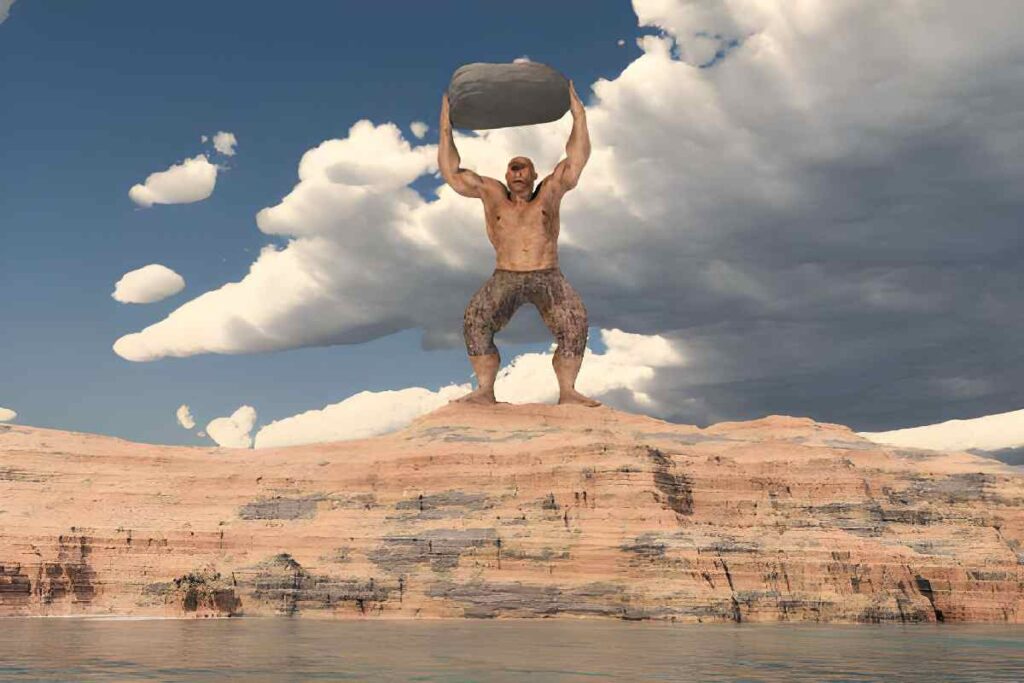
The Cyclops Was Never Just a Monster
Here’s what bugs me about most retellings: they act like the Cyclops is just some random scary thing Homer threw into the Odyssey. Wrong.
When you read Homer carefully, you notice:
- These giants lived completely outside Greek society—no laws, no farming, nothing
- Polyphemus (yeah, the famous one) basically represented everything Greeks feared about losing civilization
- The whole cave incident? That’s a lesson about xenia, the sacred guest-host relationship Greeks obsessed over
- Their shepherd lifestyle was weirdly self-sufficient but totally primitive
Odysseus stumbling into Polyphemus’s cave wasn’t adventure for adventure’s sake. Greeks used this story to literally point at the Cyclops and go, “See? This is what happens when you don’t have laws. This is barbarism. This is the nightmare version of human existence.”
Pretty heavy stuff for a monster story.

Wait, There Are Different Kinds of Cyclopes?
This threw me off when I first learned it. Turns out not every Cyclops was a cave-dwelling shepherd who ate people.
The Blacksmith Cyclopes Nobody Talks About
Hesiod’s “Theogony” introduces us to three completely different Cyclopes:
- Brontes (his name literally means Thunder)
- Steropes (Lightning)
- Arges (Brightness)
These weren’t eating sailors. They were underground, forging Zeus’s thunderbolts and basically creating the weapons of the gods.
See what happened there? Greeks were watching lightning storms and volcanic eruptions and going, “Yeah, that’s gotta be giant blacksmiths working underground.” It’s how they explained stuff that seemed impossible.
I actually visited Mount Etna a few years back—where legends said these forges existed. Standing there watching the volcanic activity, the smoke, the red glow at night… I got it. If I didn’t know about geology and just saw that mountain breathing fire, I’d probably think giant craftsmen too.
Why This Split Personality Matters
The Cyclops represents both destruction and creation. The savage ones? Pure chaos, untamed nature that’ll kill you. The craftsman ones? Human ingenuity and progress, just scaled up to mythical proportions.
That duality isn’t an accident. It’s ancient Greeks wrestling with the fact that nature can be brutally dangerous AND the source of everything useful.
The Fossil Theory That Blew My Mind
Okay, this is where things get absolutely fascinating.
Back in 1914, this paleontologist named Othenio Abel looked at dwarf elephant skulls found all over Mediterranean islands and had a lightbulb moment.
Check this out:
- Dwarf elephant skulls have this massive hole right in the center—it’s the nasal cavity
- If you’ve never seen an elephant and you dig up this skull, that center hole looks EXACTLY like a giant eye socket
- These fossils show up in all the places where Cyclops legends originated
- Ancient Greeks had zero context for elephant anatomy
I’ve actually held one of these skulls. Abel wasn’t making this up—the resemblance is uncanny. Picture yourself as a Bronze Age farmer. You’re digging and hit something hard. You unearth this enormous skull with bones thick as your arm and a single massive “eye socket” staring back at you.
Yeah, you’re going home and telling everyone you found proof of giants.
The Social Commentary Greeks Snuck Into These Stories
What can be inferred about the Cyclops goes way deeper than physical descriptions. Greeks were doing serious cultural work with these myths.
Look at what the Polyphemus story actually teaches:
It’s a whole blueprint of Greek values:
- Greeks lived in communities; Cyclopes isolated themselves in caves
- Greeks farmed and built civilizations; Cyclopes just had sheep
- Greeks created legal systems; Cyclopes lived by pure strength
- Greeks treated guests like sacred visitors; Polyphemus literally ate his guests
Intelligence always beats raw power:
- Odysseus was smaller, weaker, totally outmatched physically
- But he used wine (civilization in a bottle) to get the Cyclops drunk
- The “Nobody” trick was pure cunning—using language itself as a weapon
- Brain over brawn, every single time
Every Greek kid heard this and learned the lesson: being smart and civilized beats being big and savage.
That’s propaganda, honestly. Really effective propaganda.
Different Places, Different Cyclopes
The myths shifted depending on where you were in the Mediterranean, which tells us these stories evolved with real places and real concerns.
In Sicily:
- Cyclopes connected directly to volcanic activity—Mount Etna especially
- People heard underground rumblings and saw lava and went “yep, giant forges”
- The local geology (massive caves, volcanic terrain) shaped every detail
In Thrace and Asia Minor:
- Cyclopes supposedly built walls so massive humans couldn’t manage it
- “Cyclopean masonry” became the term for any stonework that seemed impossible
- They were explaining away prehistoric megalithic structures nobody understood
I’ve walked through Mycenaean ruins with their gigantic stone blocks. Some of these stones weigh several tons and fit together with almost no gaps. No mortar, no machinery we can see evidence of. Standing there, I completely understand why ancient peoples said, “Giants did this.” The engineering honestly does seem superhuman.
That Single Eye Means Something
The one-eye thing isn’t just to make them look scary. It’s symbolic as hell.
Here’s what scholars think it represents:
- Limited perspective: One eye means you can’t judge depth or distance properly—you’re literally seeing wrong
- Narrow focus: Cyclopes are single-minded, brutal, lacking wisdom or broader understanding
- Craftsmanship intensity: For the blacksmith Cyclopes, maybe it’s about focused concentration on their work
- Sun connections: Some researchers link it to solar worship and sky observation
Think about the symbolism: humans have two eyes for balanced, three-dimensional vision. We see completely. Cyclopes have one eye—unbalanced, incomplete, flawed perception.
That physical difference mirrors their moral deficiencies. Greeks weren’t subtle about this.
What Archaeologists Have Actually Found
Recent digs have turned up some interesting stuff that connects to Cyclops myths in unexpected ways.
Researchers keep finding:
- Bronze Age settlements right near places associated with Cyclops legends
- Evidence of ancient mining operations that might’ve inspired the forge stories
- Trade routes that spread similar giant myths across multiple cultures
- Megalithic structures that honestly do look impossible without superhuman help
The Greeks kept stumbling across ruins from earlier civilizations—Mycenaean fortresses built centuries before, Minoan palaces nobody remembered building. They needed explanations for how massive stones got moved and stacked.
The Cyclops explanation? It worked.
What Modern Experts Say Now
Looking at these myths through psychology, anthropology, and comparative mythology reveals patterns Greeks probably didn’t consciously intend.
Psychological reading:
- Cyclopes are pure appetite—the id without any social control or conscience
- The single eye suggests incomplete consciousness, like they’re missing part of what makes someone fully aware
- Polyphemus in his dark cave is basically the unconscious mind—primitive, dangerous, operating on base instincts
Anthropological take:
- These myths might preserve actual cultural memories of pre-Greek peoples living in these areas
- They conveniently justified Greek colonization—”we’re civilizing barbarian lands”
- They created in-group identity by contrasting Greeks with monstrous Others
Comparative mythology angle:
- One-eyed giants pop up in Norse myths, Celtic stories, Slavic folklore
- Either cultures shared these stories through contact, or humans universally create this archetype
- Giants generally represent forces beyond human control—nature, chaos, the unknown
How Art Changed the Cyclops Over Time
The way people depicted Cyclopes across centuries shows shifting attitudes and concerns.
Ancient artwork:
- Greek vase paintings made Polyphemus look bestial, threatening, almost animal-like
- Sicilian coins featured Cyclopes as symbols of regional pride and identity
- Roman mosaics loved showing the blinding scene—always dramatic, always violent
Later interpretations:
- Medieval writers turned them into allegories for sin or spiritual blindness
- Renaissance artists made them more human, sometimes even sympathetic
- Modern versions range wildly—from tragic figures to pure horror
Each generation remade the Cyclops to fit what they needed it to represent.
What All This Tells Us About Ancient Greeks
So what can be inferred about the Cyclops when you step back and look at everything?
These creatures were sophisticated cultural tools that did heavy lifting for Greek society.
They helped Greeks:
- Define their own identity by showing what they weren’t
- Make sense of natural phenomena like volcanoes, thunder, earthquakes
- Remember earlier peoples and unexplainable structures
- Teach kids moral lessons about civilization versus barbarism
- Process weird discoveries—fossils they couldn’t identify, ruins they couldn’t explain
The Cyclops functioned as a mirror. By showing what Greeks rejected, feared, or didn’t understand, these myths clarified what Greeks valued and believed.
These stories survived millennia because they tackle fundamental human tensions: nature versus culture, strength versus intelligence, isolation versus community. We’re still wrestling with these exact themes today, which is why one-eyed giants keep showing up in our movies, books, and games.
Next time you see a Cyclops somewhere, remember you’re looking at a concept that’s been refined and reinterpreted for thousands of years. Ancient shepherds, medieval monks, Renaissance artists, and modern screenwriters have all added layers to what that single eye means. What can be inferred about the Cyclops keeps evolving because every generation finds new meanings in these ancient, strange, surprisingly relevant monsters.
Also Read : https://humantotech.com/reelcraft-ai/