
how to Identify if a Pashmina Shawl Is Genuine ?
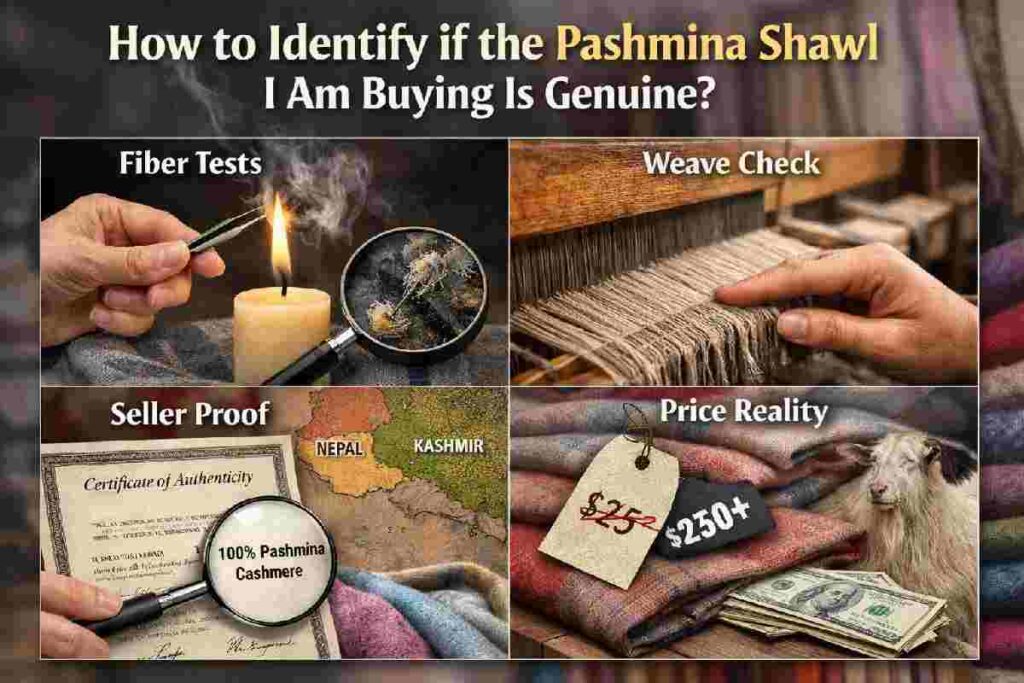
Most fake pashmina shawls pass basic touch tests. The only reliable way to verify authenticity is a layered method that checks fiber behaviour, weave structure, seller transparency, and realistic pricing together.
If you’re trying to figure out how to identify if the pashmina shawl i am buying is genuine, here’s the straight answer: no single trick works. The popular ring test and quick feel test are easy to fool. Sellers know them too. You need a multi-signal approach.
Buyers often get stuck between high prices and confusing claims. That confusion leads to overpaying for blends — or skipping a good piece out of fear. This guide gives you a practical, step-by-step verification framework you can actually use.
Key Takeaways
-
No single test proves a shawl is genuine pashmina.
-
Fiber behavior matters more than marketing labels.
-
Real pashmina has price floors — “cheap luxury” is a red flag.
-
Origin + documentation + weave irregularity are strong signals.
-
Online buyers must verify seller proof, not just product photos.
Why Most Pashmina Authentication Advice Falls Short
For decades, pashmina authentication followed a simple playbook: pull a thread from the fringe, light it on fire, and see if it smells like burning hair. If it did, you had the real thing. If it melted plasticky, you’d been duped.
That worked when counterfeits were crude polyester knockoffs. It doesn’t work anymore.
Modern textile manufacturing has gotten sophisticated. High-grade modal (a semi-synthetic fiber derived from beech trees) feels silky and soft. Bamboo-blend fabrics drape beautifully. Microfiber synthetics can be engineered to mimic the weight and texture of animal fibers closely enough to fool casual inspection. Some even burn similarly to keratin-based fibers, producing ash instead of melting.
Here’s the uncomfortable truth: if your authentication strategy relies solely on tests that can be found in a quick Google search, counterfeiters have already adapted to them. They read the same guides you do. They know buyers check for softness, so they use high-quality synthetics that feel luxurious. They know buyers do burn tests, so they create blends that pass. They know buyers distrust cheap pricing, so they charge $300 for a $40 product to manufacture perceived value.
Illustrative scenario: A buyer in New York purchases a “100% pashmina” shawl from a seemingly reputable online boutique for $275. She does the burn test—smells like burning hair, forms ash. She does the feel test—incredibly soft. She checks the price—premium, so it must be real. Six months later, the shawl has pilled aggressively along fold lines and lost its warmth retention. A laboratory fiber analysis reveals it’s 60% viscose, 30% polyester, 10% low-grade cashmere. The burn test “passed” because of the small cashmere fraction. The feel test “passed” because viscose is naturally silky. The price was pure markup.
This isn’t to say traditional tests are useless—they’re not. But they’ve been downgraded from sufficient proof to necessary-but-not-sufficient evidence. You need a more intelligent, layered approach.
Core At-Home Tests (Beginner-Friendly)
These DIY checks mimic lab tests—do them discreetly in stores.
Burn Test
Snip a fringe thread (ask permission). Burn it: genuine crumbles to ash smelling like human hair (protein fiber); fakes melt into plastic beads with chemical odor. Powdery residue confirms—no hard lumps.
Rub Test
Rub a corner briskly in dim light. Real pashmina stays neutral; synthetics spark static and attract lint (polyester trait).
Ring Test
Thread shawl through a wedding ring or coin hole. Authentic glides through entirely—its weave is that fine (under 250g often).
Warmth & Shine Test
Hold to skin: genuine warms instantly, matte finish. Fakes feel cool/slippery, often shiny under light.
The 4-Layer Authenticity Framework (Core Method)
Most guides give you isolated tricks. I recommend a 4-layer check. One layer can mislead. Four together are hard to fake.
Layer 1 — Fiber Behavior Tests
These are quick indicators — not final proof.
Touch & warmth
-
Genuine pashmina feels warm quickly.
-
It is soft but not slippery like silk.
-
It has a slightly “alive” grip, not plastic smoothness.
Moisture response
-
Natural fibers absorb a tiny bit of moisture.
-
Synthetics tend to repel.
Burn test (small loose thread only, safely)
-
Real pashmina/cashmere smells like burnt hair.
-
Ash is soft and crushable.
-
Synthetics smell chemical and bead.
Limit: Blends with high natural fiber can still pass this.
Layer 2 — Weave & Structure Signals
Real pashmina is often hand-woven.
Check for:
-
Slight weave irregularity (not machine perfect)
-
Soft edge finishing, not heat-sealed edges
-
Light weight but strong warmth
-
Subtle thickness variation across surface
Checklist
-
☐ Not perfectly uniform
-
☐ No glossy synthetic shine
-
☐ Edges look hand finished
Layer 3 — Seller Transparency Signals
Serious sellers show proof, not poetry.
Ask for:
-
Fiber composition %
-
Origin disclosure
-
Weaving method
-
Any textile lab or handicraft certification
-
Close fiber photos
Good sellers answer directly. Bad sellers deflect.
(Internal link hook: link here to a deeper guide on textile fiber labeling standards.)
Layer 4 — Price Reality Check
True pashmina has a cost floor due to:
-
Limited fiber yield per goat
-
Manual combing collection
-
Hand spinning
-
Hand weaving time
If a “100% pashmina” shawl is priced like a mass scarf, it’s almost certainly not genuine.
At-Home Tests vs Lab Tests
| Method | Accuracy | Cost | Practical for Buyers | Notes |
|---|---|---|---|---|
| DIY touch/burn | Low–medium | Low | Yes | Good filter only |
| Microscope | Medium | Medium | Sometimes | Shows fiber diameter variation |
| Textile lab test | High | High | Rare | Best proof |
Professional textile labs and government handicraft testing centers provide fiber analysis — this is the gold standard.
Country-Wise Market Reality (Pashmina Buying)
| Country | Market Pattern | Typical Price Band | Mislabel Risk | Buyer Tip |
|---|---|---|---|---|
| India | Strong artisan supply | Mid–high | Medium | Ask for GI/handloom proof |
| Nepal | Tourist heavy | Low–mid | High | Avoid street “luxury deals” |
| UK | Boutique retail | High | Low–medium | Check fiber disclosure |
| USA | Department stores | Mid–high | Medium | Read blend labels |
| UAE | Luxury malls | High | Medium | Verify origin story |
Brand Comparison Table (Fashion / Shawl Brands)
| Brand | Specialist Review Summary | Base Country | Pricing Tier | Trust Signals |
|---|---|---|---|---|
| Heritage Kashmir Houses | Strong artisan sourcing | India | High | Origin storytelling |
| Nepal Handloom Boutiques | Mixed authenticity | Nepal | Low–mid | Variable proof |
| Luxury Fashion Labels | Often blends | UK/Italy | Very high | Brand premium |
| Department Store Lines | Mostly blends | USA | Mid | Clear labeling |
| Artisan Co-ops | Best traceability | India/Nepal | Mid–high | Maker transparency |
Red Flags That Usually Mean “Not Genuine”
-
“100% pashmina” at bargain price
-
No fiber % listed
-
Only lifestyle photos, no fabric close-ups
-
Seller avoids origin questions
-
Perfectly uniform machine weave
-
Glossy synthetic shine
How to Buy Genuine Pashmina Online (Checklist)
-
Ask fiber percentage first.
-
Request macro fabric photos.
-
Ask origin + weaving method.
-
Compare price with realistic bands.
-
Check return policy.
-
Prefer artisan groups and transparent sellers.
(Internal link hook: link here to guide on how to vet online fashion sellers.)
Limitations & Edge Cases
-
Honest blends (pashmina + silk) can be excellent — just not pure.
-
Vintage shawls may lack documentation.
-
Only lab testing gives absolute certainty.
Authorities like national textile boards, handicraft development councils, and international wool organizations publish fiber standards — useful reference points for deeper verification.